
Identify Who Owns Martin County Property
Start with the land, not a name. Martin County's record stack runs on separate clocks and separate roles. Guessing at an owner rarely pays off. Elevate connects a situs address to a parcel and its assessment owner. Auditor detail can name a Deeded Owner, a Tax Bill party, or a Transfer Owner, while DoxPop supplies the recorded conveyance that confirms the latest grantee. Never let one screen carry the whole conclusion.
- Search the situs address in Martin County Elevate Maps and copy the parcel ID, owner label, and legal description.
- Cross-check the Auditor tax list by parcel number. Keep Deeded Owner, Tax Bill, and Transfer Owner labels separate.
- Search the owner as a grantee in DoxPop. Confirm the newest deed's recording date, parties, and tract description.
- If the grantee is an entity, check its exact name in Indiana INBiz, while treating the deed as the ownership record.
What you get is the tract's owner of record. That answer misses occupants, beneficiaries, family members, and anyone holding an unrecorded claim.
Start Martin County Ownership by Address
A full situs address is the cleanest opening clue. Elevate documents support searching by address, Parcel ID, or Owner Name. If the complete address fails, drop back to the street name alone, then move to the Auditor portal with the city included, as its instructions request. A legal description works after a mailing label changes.
Never treat a ZIP code as a city boundary. Loogootee 47553, Shoals 47581, and Crane 47522 are mailing anchors, not geography. Fringe parcels need more digging. A tract near an installation or county edge may take a town name, tax district, parcel number, and legal description together to pin down its place. Splits within the last two years add a wrinkle. The Auditor advises searching the owner's last name to pull every bill after a split or combination.
Trace Martin County Ownership Sources
Each source answers one piece of the ownership puzzle. The assessor roll is convenient and current. It reflects its own assessment cycle, the Auditor adds dated roles and tax context, the Recorder keeps the title-affecting instruments, and GIS map layers supply the geographic bearings.
| Where Ownership Appears | What It Gives | How Current |
|---|---|---|
| Assessor and Elevate | Assessment owner, parcel card, situs and parcel ID | Annual January 1 assessment cycle |
| Auditor tax detail | Deeded Owner, Owner, Tax Bill or Transfer Owner roles when shown | Dated roll and payable-year context |
| Recorder and DoxPop | Grantor, grantee, recording date and deed reference | Newest accepted instrument, subject to county verification |
| Elevate parcel map | Owner and surrounding parcel context | Viewer display may follow assessment updates |
The Martin County Treasurer sends real-estate bills to the owner of record. The billing snapshot comes from January 1 of the prior year. Recording moves faster than billing. A deed recorded later can name a new grantee. The tax bill still shows the old one. So a tax-field owner in Martin County property records may lag behind the recorder's clock.
Separate Martin County Owner Labels
A Martin Auditor sample shows the local labels clearly. One detail page displays a Deeded Owner field with its date. Another page carries an Owner date. That one also lists Tax Bill. It names Transfer Owner too, among the parties tied to the parcel. These labels mark different steps in county administration. The Martin County Auditor source capture documents the office that manages transfers and tax administration.
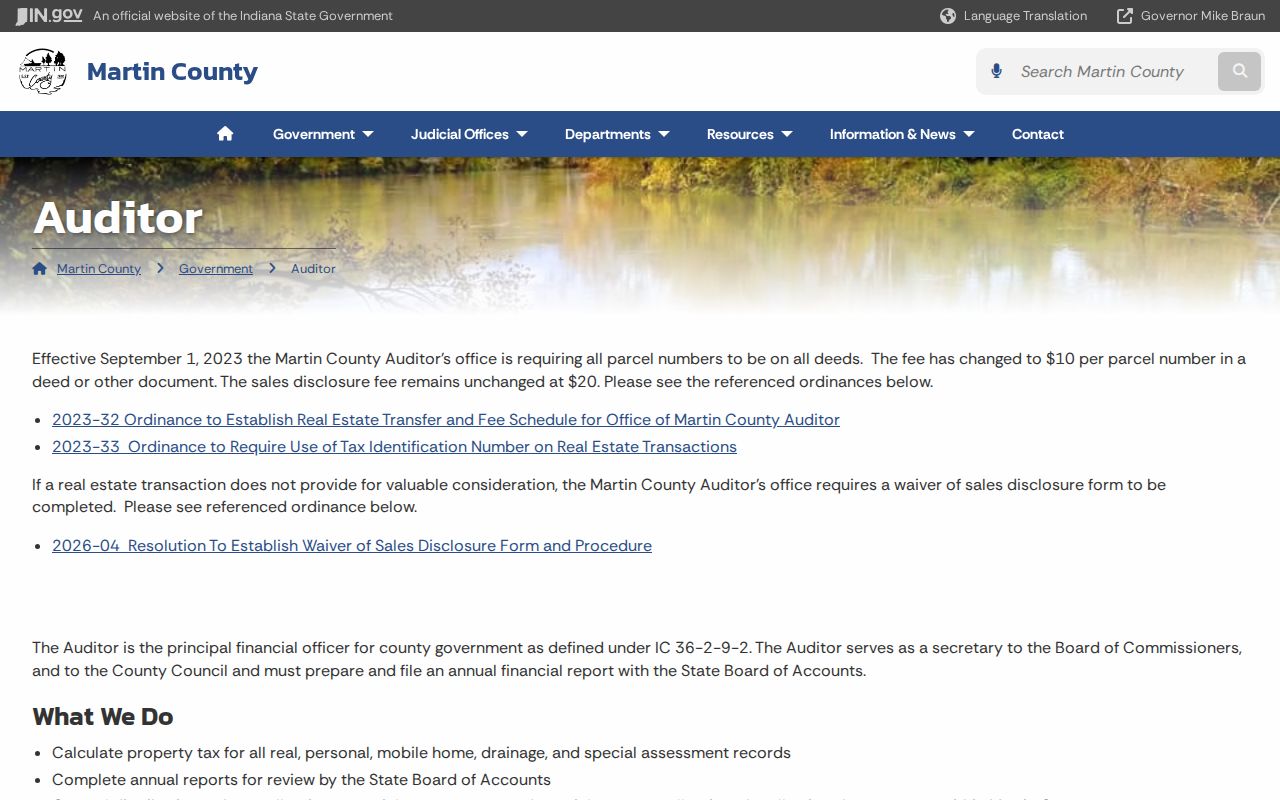
Turn to the office page when dated fields conflict. It also helps when a parcel split has not yet settled across every county system.
Note: Save the exact role label and its date instead of flattening every party field into the single word owner.
Confirm Martin County's Latest Grantee
DoxPop offers Martin County's practical online recorder index, reaching back to about January 1, 2003. Search the name in both grantor and grantee roles. Then compare parcel details, legal-description words, and recording dates. The newest matching grantee beats a prior-year tax-bill name as evidence. The vendor cautions, though, that its data is not the official record.
The Martin County Recorder holds the official copies. A request should name the instrument or the book and page. Say whether an ordinary or certified copy is needed. Include requester and return details too. Copies up to 11 by 17 inches cost $1 per page, and certification adds $5. For mailed returns, the recorder asks for a self-addressed stamped envelope.
The full proof mechanics live elsewhere. The Martin County deed records resource covers recorded evidence in depth.
Resolve Martin County Entity Owners
Not every owner of record in Martin County is a person. The name on a deed may belong to an LLC. It may also name a corporation, a trust, an estate, a land bank, a trustee, or a public body. Copy the recorded name exactly as written, punctuation and capacity terms included. From there, Indiana INBiz shows a business entity's standing and filings. INBiz helps confirm that an entity exists. It does not prove that the entity owns the parcel.
Trusts and estates call for extra care. A trustee named in a deed acts in a stated role. An executor or personal representative may sign on behalf of an estate. The recorded instrument may not list every beneficiary. A tax roll should never be used to infer one.
- Owner of record
- The party shown by the relevant official ownership or assessment record.
- Grantee
- The party receiving an interest in a recorded deed.
- Title
- The legal ownership interest, which is not proven by one portal label alone.
- Situs address
- The physical location of the land, distinct from the owner's mailing address.
Trace Martin County Court Transfers
Some ownership trails break the pattern of a normal sale. Probate, foreclosure, quiet-title, partition, and lien-enforcement cases in Martin County can all explain why. Indiana MyCase offers public, nonconfidential case shells plus some documents. Older or sealed material may be missing. Search by party name, court, status, and filing date. For the official record, ask the Martin County Clerk.
A case status alone settles nothing about ownership. Match the judgment, order, sheriff's deed, personal representative's deed, or later conveyance to the same legal description. Then follow up with the recorder, because that step is essential.
Watch New Martin County Instruments
The Recorder posts a link to DoxPop Property Watch, a free alert service. You sign up a name or a parcel. It flags newly recorded documents in Martin County. That makes it a useful follow-up after an ownership lookup. The lookup surfaces a current owner of record. It is only a watch, though. The service cannot stop fraud, certify title, or vouch that every filing is valid.
The official Recorder page shows the Property Watch sign-up screen. It also shows its entry point for new instrument alerts.
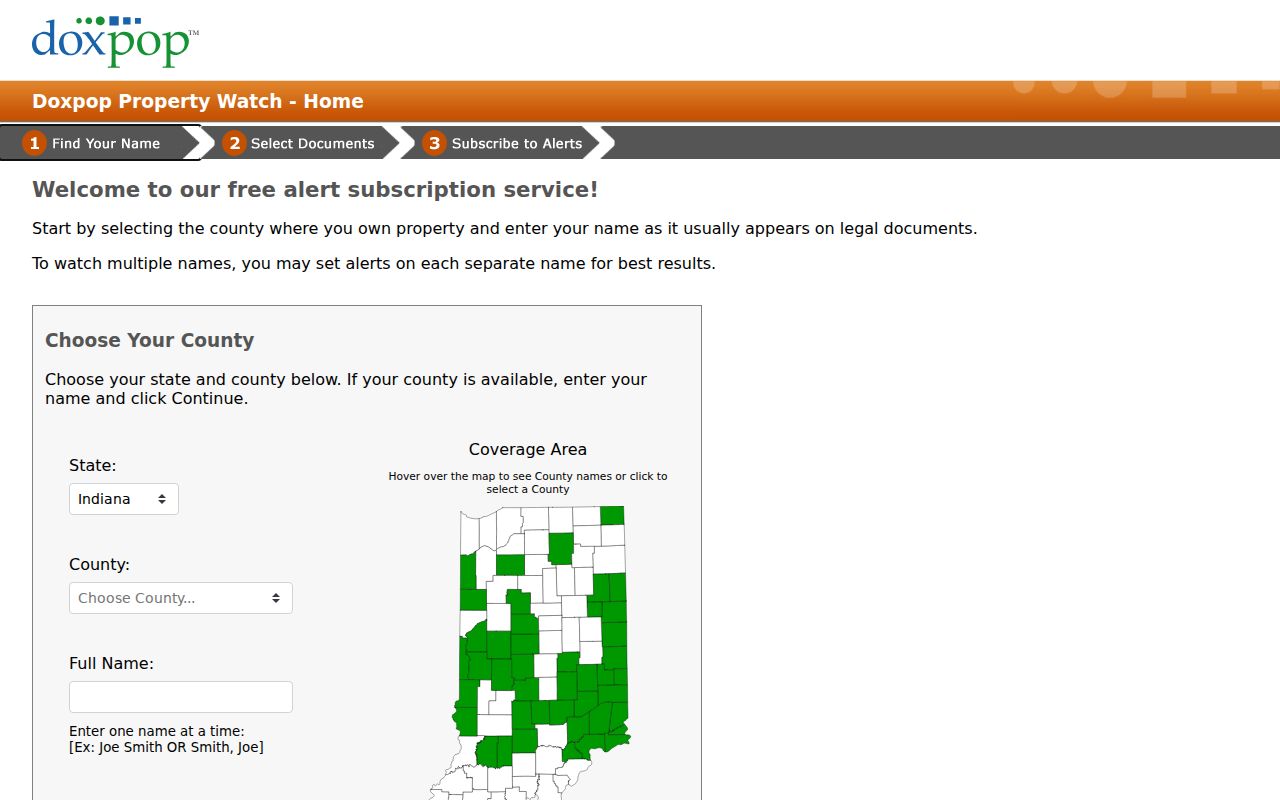
Check any alert against the recorder's official instrument before you act on it. If a Martin County filing looks unexpected, contact the recorder's office to confirm what was recorded.
Request Missing Martin County Owner Records
Portals have gaps. The online property search can come up empty. Go straight to the office that holds the record. The Assessor can hand you a property record card plus assessment context. The Auditor sorts out tax roll roles, transfers, and split or combination notation. The Recorder retrieves the deed and other title instruments you need. A written request under Indiana APRA should name the office, the parcel or address, and the record type. It should also cover a reasonable date range.
APRA sets response clocks. Acknowledgment is generally due within 24 hours for in-person or telephone requests. Mail, email, and fax submissions get seven calendar days. Production then follows within a reasonable time. Exempt fields may be redacted, and each office can charge its own copy fees.
Limit a Martin County Ownership Lookup
An owner of record is not the same as a resident. A mailing address on file might be a post office box, an entity office, another parcel, or a stale notice address. Protected fields can be withheld entirely. Indiana's Address Confidentiality Program gives qualifying survivors a substitute address. No one should try to reverse a protected address.
The recorder's records have limits too. Ownership can carry unrecorded interests, recording errors, litigation, easements, or a sale that has not yet reached every tax roll. A property search is not a title examination. Get official instruments and qualified advice before any purchase, boundary, or estate decision turns on the answer.
Use owner records lawfully. Martin County ownership data supports property diligence and civic research. Never use it to stalk, harass, intimidate, or defeat a protected address.