
Trace Back Martin County Former Owners
Reconstructing former owners of Martin County land happens one transfer at a time. Take the current deed first. Its grantor becomes the next earlier grantee you hunt for. Alongside every name, record the legal description, parcel references, and recording details. That keeps nothing drifting off the same tract. A timeline built this way reflects the actual deed evidence. It never shows guessed owners for a sample parcel.
| Transfer Date | Grantor to Grantee | Deed Type | Book or Page |
|---|---|---|---|
| Newest recorded date | Prior owner to current grantee | As indexed | Instrument or book/page |
| Earlier recorded date | Earlier owner to that prior owner | As indexed | Cross-reference from deed |
| Repeat backward | Each prior grantor found as a grantee | Warranty, quitclaim, representative, or other | Exact volume and page |
Deeds filed from roughly January 1, 2003 onward are searchable online through DoxPop. Earlier owners call for the Recorder's general indexes and deed books. Microfilm copies sit with the State Library. That 2003 line only marks where digital coverage begins. It says nothing about the start of Martin County title history.
Go Back Past Martin County's 2003 Cutoff
The DoxPop partner table gives Martin County a January 2003 start, and the county announcement likewise describes documents filed on or after January 1, 2003. Search both grantor and grantee roles, widen the date window, and try name variants. OCR and full-text search can surface legal-description or easement words. Faint scans, though, sometimes hide matches that really exist. Treat the vendor index as a discovery tool. DoxPop itself warns that its data is not the official record. Capture the instrument number, recording date, parties, deed type, legal description, and any prior book and page reference. Then confirm the instrument with the Recorder.
Coverage boundary. Martin County's online deed index begins around 2003. Earlier former owners continue in general indexes, deed books, and microfilm.
Reconstruct Martin County's Deed Chain
Work in reverse order. Prove each deed concerns the same tract. A shared surname alone proves nothing. Parcel IDs can change over the years, but lot, block, section, acreage, exceptions, and prior-instrument references preserve the thread from one owner to the next.
- Find the current acquisition deed and record the grantee, grantor, date, instrument, and full legal description.
- Search that grantor as a grantee in an earlier period. Confirm the same tract from description and cross-references.
- Repeat for each earlier grantor. Note estate, trustee, sheriff, tax, or court language that may explain a break.
- At the online cutoff, use the general grantor or grantee index to locate the deed volume and page.
- Grantor
- The party conveying an interest.
- Grantee
- The party receiving the stated interest.
- Chain of title
- The linked sequence of recorded transfers for the same land.
- Reverse index
- An index organized from the receiving-party side, useful for finding how a grantor once acquired land.
- Quitclaim and warranty deed
- Different deed forms whose legal effect must be read from the instrument, not assumed from the label.
Retrieve Martin County Deed Microfilm
The Indiana State Library inventory covers Martin County. It holds land and deed material from 1820 through 1947. General grantor index volumes 1 through 4 span 1820 through 1875. Deed reels listed in the inventory run from 1820 into the 1880s and beyond. Before asking for access, note the reel title, volume, years, index direction, and GSU number. Microfilm is open for onsite use on the library's second floor under its collection rules. The Recorder stays the active custodian for title instruments and certified copies. Libraries help bridge the old chain. They do not certify current title. Note: A 2003 deed may cite a nineteenth-century book and page. That lets the chain jump straight into an older volume.
Translate Martin County's Old Place Names
Old maps keep former owners tied to the right land. Road and town names changed over time. Shoals was platted as Memphis in 1844. Loogootee's recorded origins include an 1818 land purchase and an 1826 tax resale. The town's original plat was filed in 1853. Hindostan carries an 1819 plat. Where the legal description supports it, search those older names. The 1892 Martin County atlas in Indiana Memory adds context to the hunt. It covers county, township, and town maps.
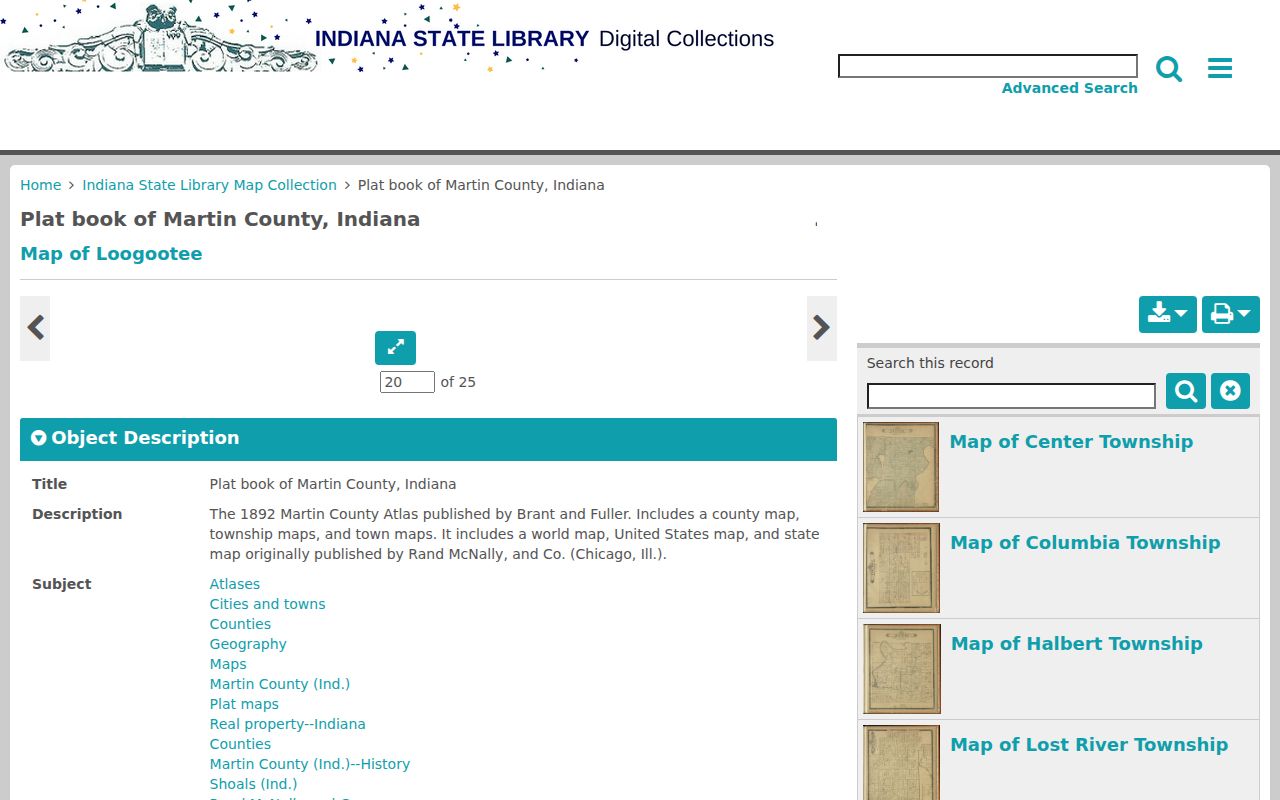
The atlas orients an old deed in its era. It cannot reveal today's owner or settle a present boundary question.
Keep Martin County Tract Clues Together
Copy legal descriptions exactly as written. Keep the lot and block, section-township-range, metes-and-bounds calls, acreage, road or river references, and qualifiers such as "part of," "except," or "less." A tidy street address can hide the very clue separating two tracts held by men with the same name. Martin County's Auditor sample shows the trap. The legal description reads "1972 Liberty Shaded Estates Lot 11," while the location display reads "548 Shaded Estates - Lot 11." Either phrase may aid a search. Still, the deed description and parcel trail decide whether a former owner truly belongs in the chain.
Catch Martin County Non-Sale Transfers
Prior owners entered through probate or a trustee deed. Others left through a sheriff's deed or quiet title. Partition or another court-backed transfer also appears. Search MyCase by party and date range. Ask the Martin County Clerk when an older document or image is missing. Always match the court result to a recorded instrument. Martin County's 2026 sales-disclosure waiver process adds a timely caution. A no-expense or no-sale transfer may carry waiver paperwork rather than a normal sale-disclosure amount. A blank price does not mean no transfer occurred. Read the waiver, the deed, and the Auditor transfer fields together.
Separate Martin County Same-Name Owners
Names repeat in every county. Search surname-first, and try first-name variants, initials, married names, executor labels, and differing entity punctuation. Then split candidates apart. Use the tract description, parcel, tax district, date, and adjoining or prior references. Matching names alone never justify joining records. An older deed index may list a spouse, trustee, guardian, witness, or release party. Read the role in the full instrument. Only then call anyone a former owner. The distinction matters most in mortgage releases and estate records.
Order Martin County's Missing Link
Need a copy of an old Martin County deed? The Martin County Recorder fills requests keyed to an instrument number. A book and page citation works just as well. Say whether you want an ordinary or certified copy. Give your mailing details for the return. Copies up to 11 by 17 inches run $1 per page, while certification adds $5. A self-addressed stamped envelope is required. For a fuller walkthrough of the deed-copy process, see Martin County deed records.
When an index entry is missing, an Indiana APRA request works best when it is reasonably particular. Give the parcel number or legal description, the prior owner of record, the record type, and the date span you need. The law calls for prompt acknowledgment. Production time still depends on the scope of the retrieval work.
Reach Martin County's Earliest Owners
Martin County formed in 1820 from Daviess and Dubois counties. The State Library holds Martin land entries from 1807 through 1820. It also holds land patents and county deed material that begins in 1820. A transaction from before county formation may live in a federal land entry, a patent, or a parent-county record. It may not sit in a Martin County deed book at all.
That time depth makes former-owner research possible across two centuries. It also sets limits. An index can point to an instrument without proving every interest. A historic map can name a place without proving a boundary. Even a name in a deed does not confirm ownership. That name does not always mean the person was an owner of record. Build the chain backward from the documents themselves, one parcel number and deed at a time. Let each record support the next.
Use history with care. Trace Martin County former owners for land history, estate work, or diligence. Never use the record trail to harass or track a living person.