
Read Martin County Tax Fields
Every field in a Martin County tax record has a keeper. The Assessor sets and defends property value. That office also maintains the property record card. The Auditor calculates the tax, processes transfers and deductions, and publishes the CGI tax list. The Treasurer mails the tax bill and takes payment. That office adds penalties and handles tax-sale questions. Match each field to its office before you draw conclusions from a deed search.
| Field | What It Shows | Where |
|---|---|---|
| Gross assessment | Value before allowed deductions | Assessor and tax detail |
| Deductions and exemptions | Approved reductions or exempt status | Auditor and Assessor |
| Net assessment | Assessment remaining after deductions | Tax detail and bill |
| Tax district and rate | The local taxing context used for the bill | Auditor tax roll |
| Gross and net tax | Charges before and after credits or caps | Tax detail and TS-1 |
| Balance and payment | Collection status, penalties, and payment route | Treasurer |
Indiana assesses at market value-in-use with a 100 percent assessment ratio. Yet an assessed figure is not a sale appraisal. A deed's stated consideration may reflect a special transfer between family members. Some transactions are excluded from ratio work entirely. Treat every tax number in Martin County property records as a figure for its stated year and purpose. It is nothing more.
Martin Tax Search Fields
The Auditor's Martin County property search list offers District number, Parcel number, Name, Tax Year, and Property Address. Its instructions favor one strong clue at a time. Use the parcel number if you have it. Or try a last name. The address with its city works too. Piling on extra criteria only restricts the results. The tax list itself carries a plain warning: "Not for Official Use!"
| Search input | Use | Local caution |
|---|---|---|
| District number | Narrow a known tax district | Confirm the portal's exact format |
| Parcel number | Find the current tax tract | Copy punctuation and leading zeros |
| Name | Find one or several bills | Try last name first |
| Tax year | Choose the record cycle | Assessment and payable years differ |
| Property address | Find the physical site | Include city as instructed |
The Treasurer keeps its own copy of the tax roll, though it carries the same public-use caution. The Elevate view layers in the parcel card and a map. Even so, payment status lives with the Treasurer alone.
Martin's Two Tax Clocks
Real property is assessed on January 1 each year. The Treasurer says bills go to the real-estate owner of record as of January 1 of the prior year. This creates a predictable lag. A deed recorded after the billing cutoff may show the buyer before the tax bill does.
Separate recording date, assessment date, tax year, and payable year. Also read whether a page says Deeded Owner, Owner, Tax Bill, or Transfer Owner. Those are not synonyms. If two names differ, compare the newest Recorder instrument to the dated roll field and ask the Auditor or Assessor which annual update has posted.
Look Up a Martin Tax Bill
Begin with the parcel in the Auditor list. Confirm the physical address, legal description, district, and the year you want. Then take that parcel number to the Treasurer for the amount due, payment history, escrow status, delinquency, and the tax-sale channel. A tax bill settles a collection question. It does not settle title.
- Search the Auditor or Treasurer list by complete parcel or property address.
- Confirm district, tax year, legal description, and owner-role label.
- Read assessed value, deductions, gross tax, cap credits, and net tax.
- Check the Treasurer's payment, penalty, escrow, or sale information.
- Use the Recorder for any lien instrument or deed that needs title proof.
- Assessed value
- The county value used in the tax process for a stated year.
- Tax rate
- The district rate applied in calculating the bill.
- Homestead deduction
- Approved relief reflected through the Auditor's process.
- Tax lien
- A recorded or statutory claim tied to unpaid tax, distinct from a deed.
Pay Martin County Property Tax
Statements go out in April with two coupons attached. Installments fall on May 10 and November 10, with dates adjusted for weekends and holidays. Not receiving a statement does not erase the duty to pay. The Treasurer takes cash, check, money order, or card at the office. By mail, send a check or money order with the coupon. Online payment runs through GovTechTaxPro.
The online card processor adds a 2.65 percent fee. Want a receipt by mail? Enclose a self-addressed envelope with your payment. Partial payments are welcome in any amount and at any frequency, though unpaid due sums can still draw penalties. For escrow questions, call the Treasurer at 812-247-3701.
The Martin County Treasurer page posts current collection details.
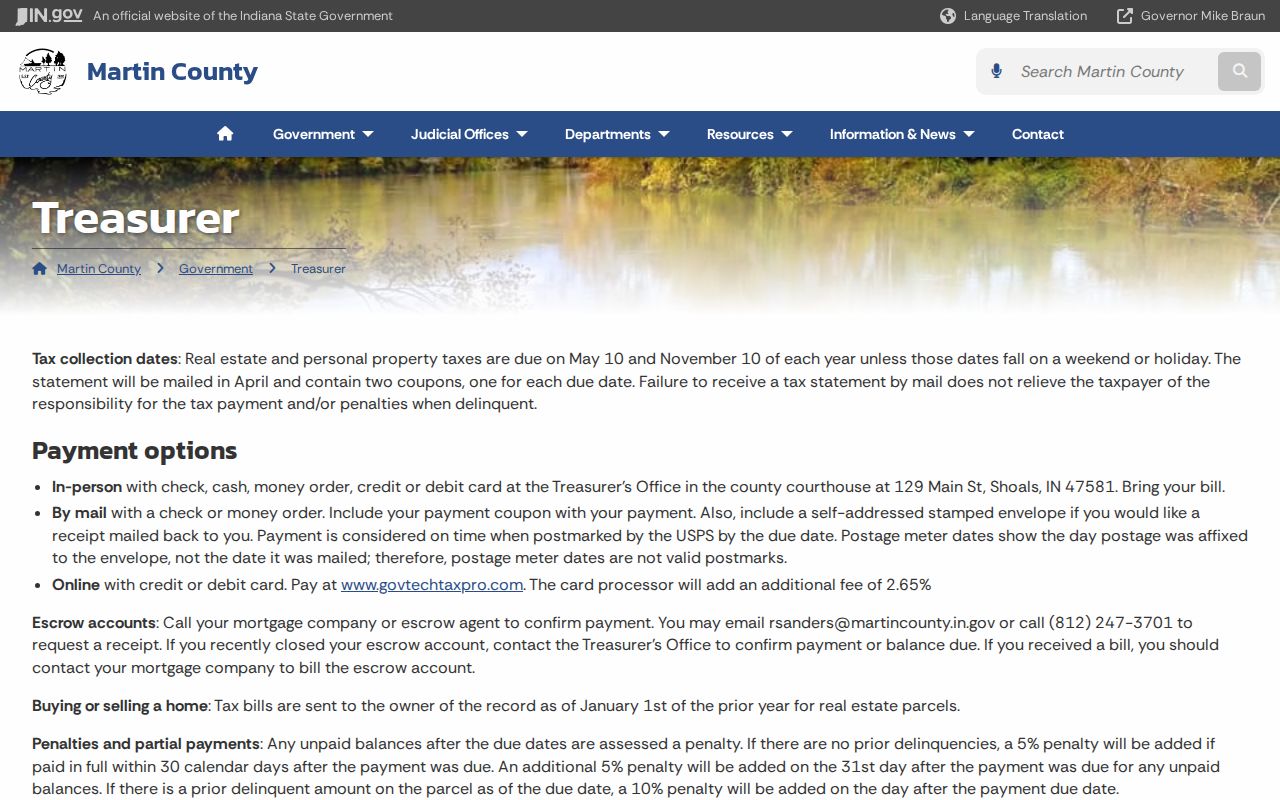
Check the office page for due-date changes before sending any payment.
Martin Tax Penalty Rules
Penalty math in Martin County depends on prior delinquency. With a clean record, a 5 percent penalty applies to any installment paid in full within 30 calendar days after the due date. Another 5 percent starts on day 31. A parcel with a prior delinquency gets a 10 percent penalty beginning the day after the due date.
Payment status and a title lien are separate questions. The Treasurer confirms the balance. A filed lien, a release, or a recorded tax deed shows up in the Recorder's deed records instead, so search there when the land trail calls for it. A pending tax-sale link or delinquent amount alone proves no ownership change.
Note: Ask for a date-stamped balance when timing affects a payment, closing, or redemption inquiry.
Martin Deductions and Exemptions
Deduction paperwork in Martin County starts with the Auditor. That office takes deduction applications for a parcel. The Assessor supplies the valuation side and also serves as PTABOA secretary. Indiana separates deductions and credits from exemptions. A tax record may display homestead and cap fields. Each field should be tied to its year and approval status before you rely on it, since an old benefit does not always carry forward after a title change.
DLGF points to Form 136 for exemption claims, with an April 1 filing framework and even-year refiling rules in applicable cases. Use the county's current forms and ask the Auditor exactly what sits on the parcel rather than assuming a benefit continued.
Martin Assessment Geography Differs
Broad value comparisons in Martin County can mislead. The county's land-order and ratio materials explain why. Country Court I through III sits in DLGF neighborhood 9081-008, a 57-parcel area carrying a factor of 1.0300. Shoals neighborhood 9040-004 is messier. It mixes an east business area with river, flood, and steep-site distinctions that push values in different directions. Crane sales vary with military-era condition and remodeling.
An assessment neighborhood is a valuation tool, not a recorded subdivision, so compare parcels within a suitable market context and turn to the recorded plat when a legal subdivision matters. Blending Loogootee subdivision data, Shoals river land, and Crane's installation-linked district into one market would distort every conclusion.
Martin's Sale Waiver Record
Martin County adopted a sales-disclosure waiver process by resolution in 2026. It covers transfers with no expense or no actual sale. Each waiver needs supporting papers. So when a property record shows no ordinary sale amount, the likely answer is a waiver. It is not a missing deed transfer.
Search the Auditor's waiver files alongside the Recorder's deed records before drawing conclusions. The DLGF also leaves private, contract, and other nonmarket deals out of its ratio work. One more caution applies. Sale price, assessed value, and taxable value each answer a different question. Swapping one for another invites error in any parcel review.
Appeal a Martin County Assessment
Indiana gives taxpayers a clear appeal path. File Form 130 first and request an informal conference. From there a case moves to the Property Tax Assessment Board of Appeals, known as PTABOA. Further review sits with the Indiana Board. DLGF appeal material lists June 15 as the usual filing date. The assessment notice and current Martin County instructions still control each parcel's deadline.
Bring parcel-specific evidence to the conference. Good items include the property record card, photographs, comparable sales from the same market and property type, factual errors, land-order context, and the assessment notice itself. Keep proof of filing. An appeal targets the assessed value or the facts behind it. It cannot rewrite a deed or erase a tax payment history.
Appeal window. Check the assessment notice and county instructions before June 15, then file the required Form 130 with supporting parcel evidence.